
Posted on January 6, 2026
Modern Vision Correction is Here: Elevating Options & Educating Patients
How Glacial Multimedia & Tylock Eye Center are working together to transform the patient experience
At Glacial Multimedia, we always appreciate the opportunity to take on a challenge. And 2025 presented one of the most significant challenges refractive surgeons and ophthalmologists have faced in recent times – in many ways, even more challenging than the COVID era.
We were faced with several challenges this year. Economic pressures squeezed the core demographic that historically drove LASIK adoption. Social media amplified fear-based narratives that overshadowed decades of safety data and successful outcomes. Patient hesitation increased, decision cycles lengthened, and practices found themselves needing to rebuild trust from the ground up.
But challenges also create opportunities for innovation. Rather than simply defending LASIK, we saw an opportunity to transform the conversation entirely – to shift from promoting a single procedure to educating patients about personalized vision solutions tailored to their unique needs, anatomy, and life stage.
Our partnership with Dr. Taj Nasser, Amanda Kincaid, and Randy Schaller from Tylock George Eye Care gave us the perfect opportunity to put this philosophy into practice: reinvigorating interest in vision correction through expanded options, better education, and genuine transparency
What We Were Up Against in 2025
The ophthalmology and refractive surgery industry faced several significant challenges this year, prompting us to rethink our approach to vision correction marketing entirely.
Economic Pressure on the Core LASIK Demographic
The 18–30-year-old demographic has experienced diminished purchasing power due to a combination of economic pressures that disproportionately affect younger adults.
This group, which historically adopted LASIK at earlier ages, is now facing significantly higher living expenses. Rapidly rising rent costs have consumed a larger share of disposable income, while increased reliance on financing, particularly for car payments and student debt, has reduced financial flexibility.
When combined with persistent inflation impacting everyday necessities, this age group has less discretionary income available for elective procedures like LASIK, effectively constraining their ability to purchase despite ongoing interest.
The Social Media Effect and Anti-LASIK Sentiment
Over the past three years, LASIK surgery volume has declined by nearly 20%, reflecting a combination of economic pressure and shifting consumer perception.
By 2025, this downward trend was further accelerated by a surge of anti-LASIK sentiment on social media, particularly driven by highly visible TikTok videos highlighting negative or rare adverse outcomes. These narratives, often lacking medical context or statistical balance, gained significant traction among younger audiences. Compounding the issue was the release of the documentary Broken Eyes, which reinforced fear-based messaging and amplified public skepticism around LASIK safety and outcomes.
Together, these factors contributed to increased hesitation among prospective patients, longer decision cycles, and a heightened need for education, trust-building, and transparency within LASIK marketing and patient engagement strategies.
Of course, at Glacial, we all know that LASIK is very safe and effective. In fact, several Glacial employees have had both LASIK and SMILE eye surgery.
Building a New Foundation for Vision Correction Marketing
Patients Now Have Several Vision Correction Options, Not Just LASIK
Addressing these challenges demanded a complete rethinking of how we approach vision correction marketing. We set out to work with Tylock George Eye Care to identify ways to reinvigorate interest in vision correction.
We began by looking back and reflecting on what has worked well and where we could do better. It’s always valuable to take a step back and review marketing goals and focus, then build tactics that will ultimately drive results. Regular reflection forces you to evaluate whether your marketing efforts are driving the goals that matter: qualified leads, booked consults, and revenue, not just impressions or clicks.
One thing became immediately clear: we needed a new website and a new message. For many years, Tylock George Eye Care has been known as one of the best Dallas LASIK vision correction centers. Located in Irving, Texas, the practice is uniquely positioned to serve the Dallas-Fort Worth metroplex, attracting patients from across the region. With over 40 years of combined experience in refractive surgery, the team’s expertise is undeniable.
Specifically for Tylock George Eye Care, the challenge became: How do we emphasize that experience and location in a new website while revealing a new approach to modern vision correction?
We would need to explain how we go beyond the limits of lasers and why this would benefit our patients.
The Answer: Choice, Education, and Transparency
As we mapped out our strategy for the new website and messaging, these challenges revealed a critical insight: the best solution was to expand the conversation, not necessarily to defend LASIK more forcefully.
By presenting multiple vision correction options, we could address economic concerns (offering procedures at different price points and value propositions), counter social media skepticism (showing that LASIK isn’t the only path to visual freedom), and rebuild trust through education and transparency.
Modern vision correction, with its emphasis on personalized solutions, became a key part of our answer. The strategy helped us meet patients where they are, both financially and emotionally.
Personalization Over Procedure
The first step was figuring out the best approach to explain these new forms of vision correction to patients. What became clear is that modern vision correction should be explained through the lens of personalization, not by promoting a single procedure like LASIK.
Refractive Lens Exchange (RLE), EVO ICL, and premium intraocular lenses should be presented as solutions designed for different ages, eye anatomy, and lifestyle needs.
While LASIK reshapes the cornea and works well for younger patients with healthy corneas and stable prescriptions, alternatives are recommended when LASIK would not deliver optimal or long-term results.
EVO ICL is ideal for patients with higher prescriptions or thin corneas who want excellent visual quality without altering the cornea, while RLE with premium intraocular lenses is better suited for patients over 45 who are developing presbyopia or early lens changes and want lasting correction at multiple distances.
Framing these options as tailored, life-stage–appropriate solutions helps patients understand why a non-LASIK approach may provide better outcomes, greater visual freedom, and long-term value. At the same time, it was important that we let patients know LASIK remains a great option for many people.
Our strategy centered on two key objectives:
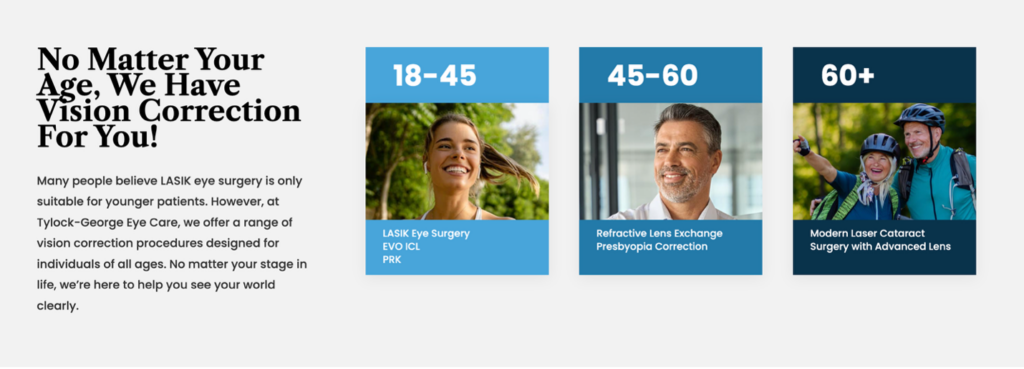
1. Show that modern vision correction can cover multiple age groups
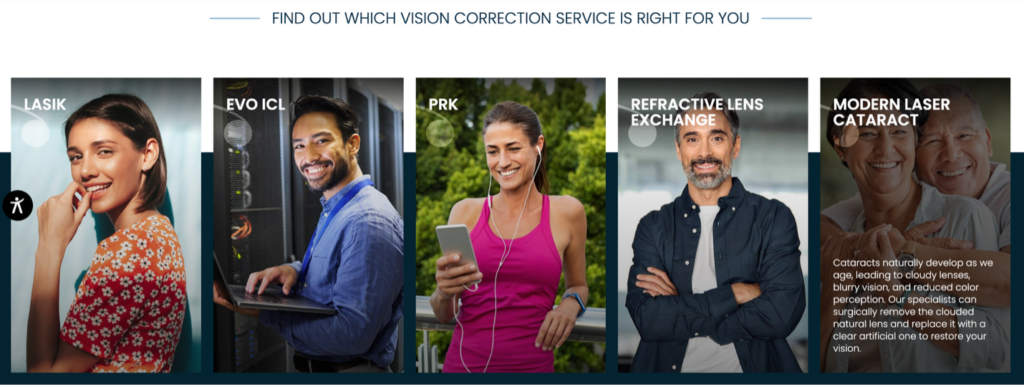
2. Present modern vision correction as more than just LASIK
Reframing Vision Correction
Modern vision correction represents a fundamental reframing of how we talk about vision correction. Instead of fitting patients into a one-procedure-fits-all model, we’re now matching the right solution to each patient’s age, eye anatomy, lifestyle, and long-term vision goals.
This reframing shifts the conversation from promoting a single procedure to designing the best possible vision for each individual. It’s a patient-first strategy that improves outcomes, satisfaction, and trust. Practices that embrace this multi-option approach are better positioned to educate patients, overcome hesitation, and deliver clearer vision at every stage of life, while future-proofing their practice against changing demographics and patient expectations.
Highlighting The Benefits Patients Care About
In developing the new website and messaging strategy for Tylock George Eye Care, we knew that listing procedures wasn’t enough. Patients don’t wake up thinking ‘I need RLE’ or ‘I want EVO ICL’, they wake up frustrated by glasses fogging up, struggling to see the scoreboard at their kid’s game, or worried about night driving safety.
Benefit-driven content is always important to remember to include. We focused on the outcomes patients actually care about:
- Eliminating or reducing the ongoing costs of glasses and contacts
- Seeing clearly while playing sports or staying active
- Reducing night driving difficulties and glare
- Achieving clear vision at multiple distances without bifocals
- Living life without the daily hassles of glasses and contact lenses
By leading with these benefits and then connecting them to the right procedure for each patient’s unique situation, we made the conversation about their life.
Modern Vision Correction for 2026 and Beyond
The vision correction industry will continue to evolve, but one thing is certain: practices that embrace a multi-option, patient-first approach will thrive. As we move into 2026, the opportunity is clear: educate patients about their options, lead with transparency, and deliver personalized solutions that match their unique needs.
At Glacial Multimedia, we’re committed to helping ophthalmology and refractive surgery practices navigate this new era. Whether you’re looking to expand beyond LASIK, refresh your messaging, or build a comprehensive modern vision correction strategy, we’re here to help.
Ready to elevate your vision correction marketing in 2026? Let’s talk about how we can work together to reinvigorate patient interest, expand your service offerings, and future-proof your practice.


